 Toyvo
Toyvo Claude Code Now Talks to Slack, Discord, and Your CI Pipeline
Anthropic's Claude Code just got real-time channels that let it react to Slack messages, CI failures, and Discord pings. Here's what that means for dev teams.
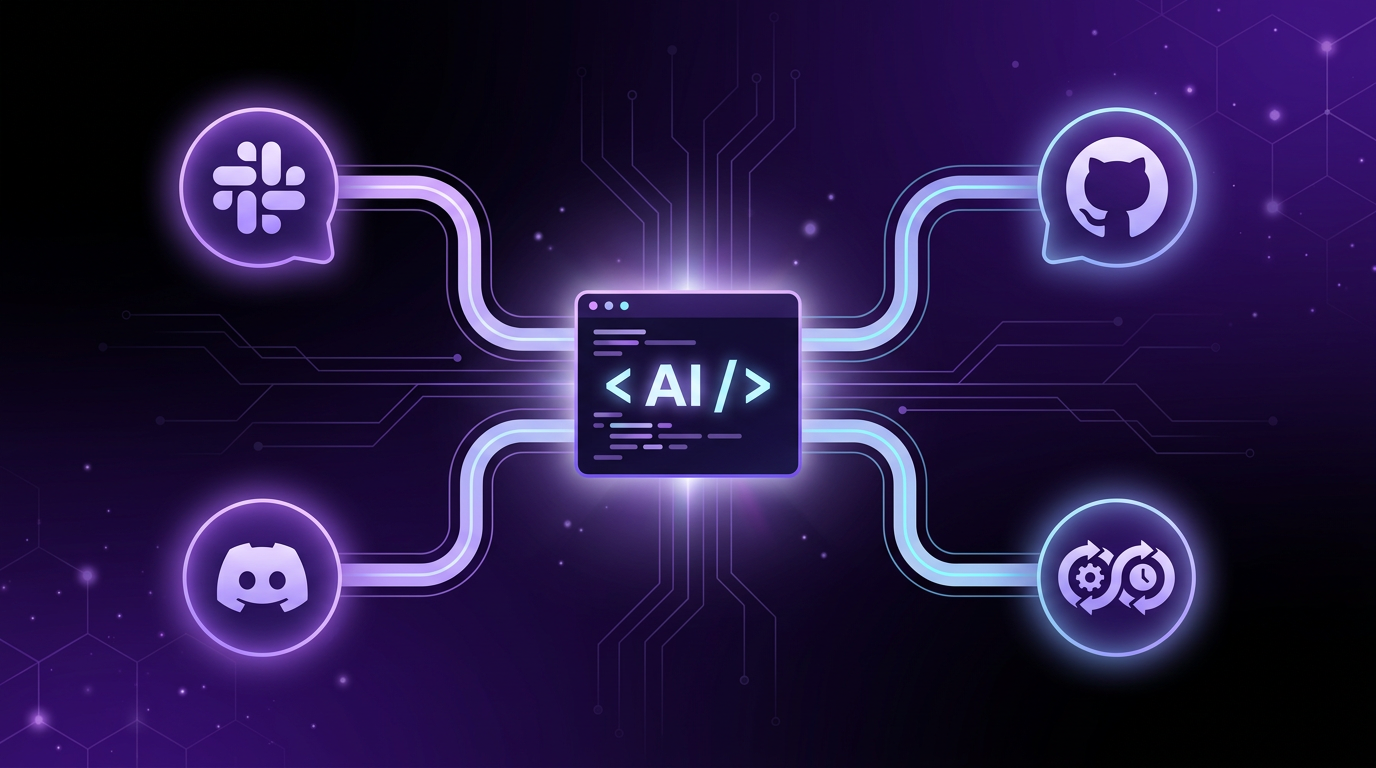
Your CI pipeline just broke. Normally, you'd get the notification, context-switch out of whatever you were doing, open the logs, figure out what went wrong, and start fixing. But what if your AI coding assistant already saw the failure, pulled up the logs, and started working on a fix before you even finished reading the alert?
That's the premise behind Channels, a new feature Anthropic shipped for Claude Code on March 20, 2026. It lets Claude Code listen and respond to events from external systems — Telegram messages, Discord pings, GitHub webhooks, CI failures, monitoring alerts — in real time.
This isn't autocomplete anymore. This is an AI agent that participates in your workflow without being asked.
What Are Channels, Exactly?
Channels are an extension of the Model Context Protocol (MCP), the open standard that Claude Code uses to connect with external tools. A channel is essentially an MCP server that pushes events into a running Claude Code session.
There are two types:
One-way channels forward alerts and webhooks. Think CI pipeline failures, monitoring alerts from Grafana, or Sentry error reports. Claude receives the event and acts on it — investigates the error, reads relevant files, runs tests — but doesn't reply to the source system.
Two-way channels add a reply mechanism. These are your chat bridges: Telegram, Discord, or any messaging platform. You send a message to a bot, it reaches Claude Code, Claude does the work, and responds back through the same channel. You can literally fix a bug from your phone while standing in line for coffee.
The built-in channels shipping with the research preview are Telegram, Discord, and a local testing tool called "fakechat." But the protocol is open — any developer can build a custom channel for their own systems.
What You Can Actually Do With This
The scenarios get interesting fast.
Fix code from your phone. DM your Telegram bot: "The checkout flow is throwing a 500 error on the staging server." Claude Code picks up the message, examines the relevant service, identifies the issue, writes a fix, runs the tests, and opens a PR. You approve it while walking to lunch.
Auto-triage GitHub webhooks. Set up a channel that listens to your GitHub webhook events. When a new issue comes in, Claude reads it, checks if it's a duplicate, labels it, and if it's a clear bug with a reproducible case, starts investigating immediately.
React to CI failures in real time. Your build breaks at 2 AM. Instead of waiting for someone to wake up and look at it, Claude Code sees the failure notification, reads the build logs, identifies the breaking change, and either fixes it or posts a detailed diagnosis in your team's Discord channel.
Monitoring alert response. Connect your Datadog or Grafana alerts to a one-way channel. When a service starts throwing errors, Claude has the context to look at recent deployments, check what changed, and start narrowing down the root cause before a human even opens their laptop.
These aren't theoretical — the Telegram and Discord plugins are available now in research preview for Claude Pro and Max plan users (version 2.1.80+).
The Bigger Picture: AI Assistants Are Becoming Teammates
Channels don't exist in a vacuum. They're part of a broader transformation in how AI coding tools work. Consider what's happened in the past few months:
Claude Code 2.0 shipped in February 2026 with multi-agent orchestration — a single command can spawn multiple specialized agents that analyze code, write implementations, run tests, and open PRs in parallel. It added persistent memory so Claude learns your codebase conventions across sessions. And it got native CI/CD integrations for GitHub Actions, GitLab CI, and Jenkins.
OpenClaw, the open-source autonomous agent framework created by Peter Steinberger, has amassed over 247,000 GitHub stars since January 2026. It lets developers run code agents from messaging apps — triggering bug fixes and PR creation from Telegram or Discord while away from the keyboard. OpenClaw works with Claude Code under the hood but adds orchestration layers for session management, plan review, and approval workflows.
Now Anthropic is building that messaging integration directly into Claude Code. The positioning is clear: they see OpenClaw's traction and they're bringing the core capability natively into their product.
GitHub Copilot is heading the same direction, expanding from autocomplete into full agent workflows with Copilot Workspace. Codex has been experimenting with Slack integrations. The pattern is unmistakable — AI coding tools are evolving from passive assistants into always-on participants in the development lifecycle.
The Security Question Nobody Should Ignore
There's a catch. An ungated channel is a prompt injection vector. If anyone who can reach your endpoint can put text in front of Claude, that's a security problem.
Anthropic's documentation addresses this directly: channels must gate inbound messages on sender identity, not chat/room identity. The built-in Telegram and Discord plugins use a pairing flow — the user DMs the bot, gets a pairing code, approves it in their Claude Code session — before any messages are forwarded.
For custom channels, the burden is on you. If you build a webhook receiver that listens on a public port without authentication, you've given the internet a direct line to your AI agent that has access to your codebase. The research preview requires a --dangerously-load-development-channels flag for custom channels, which should communicate the stakes clearly enough.
What This Means for Engineering Teams
The shift from "AI that writes code when asked" to "AI that monitors, reacts, and acts autonomously" is the most significant change in developer tooling since the introduction of CI/CD itself.
For teams scaling engineering capacity, this changes the calculus. A senior developer paired with an always-on AI agent doesn't just write code faster — they handle more surface area. Monitoring, triage, first-response debugging, routine fixes — the agent absorbs work that previously required human attention and context-switching.
This is the kind of workflow Toyvo engineers bring to client teams. AI tools integrated into every stage of development — not as a novelty, but as a core part of how shipping gets done.
Getting Started
Channels are in research preview. You need Claude Code v2.1.80+, a Claude Pro or Max plan, and the Bun runtime for the pre-built plugins. Start a session with --channels to enable the built-in Telegram or Discord bridges. Team and Enterprise organizations need an admin to enable channels in their managed settings first.
The official documentation covers the full setup, and the source for the built-in plugins is available on GitHub.
The era of AI coding assistants that sit idle waiting for a prompt is ending. The ones that watch, listen, and act are here.
Looking to scale your engineering team with AI-augmented developers? Get in touch.
Read More
Anthropic's Study Says AI Makes You Code Faster but Learn Less
A new study from Anthropic shows developers using AI assistance scored 17% lower on skill tests. Here's what it means and how to use AI without losing the ability to debug.
OpenAI Frontier Wants to Replace Your SaaS Stack With AI Agents
OpenAI's new Frontier platform puts enterprise AI agents on a collision course with traditional SaaS. Here's what it means for the software industry and engineering teams.